
COP30 Week 1 Recap
A recap of day 6 of COP30 and a full recap of negotiations and personal experience.

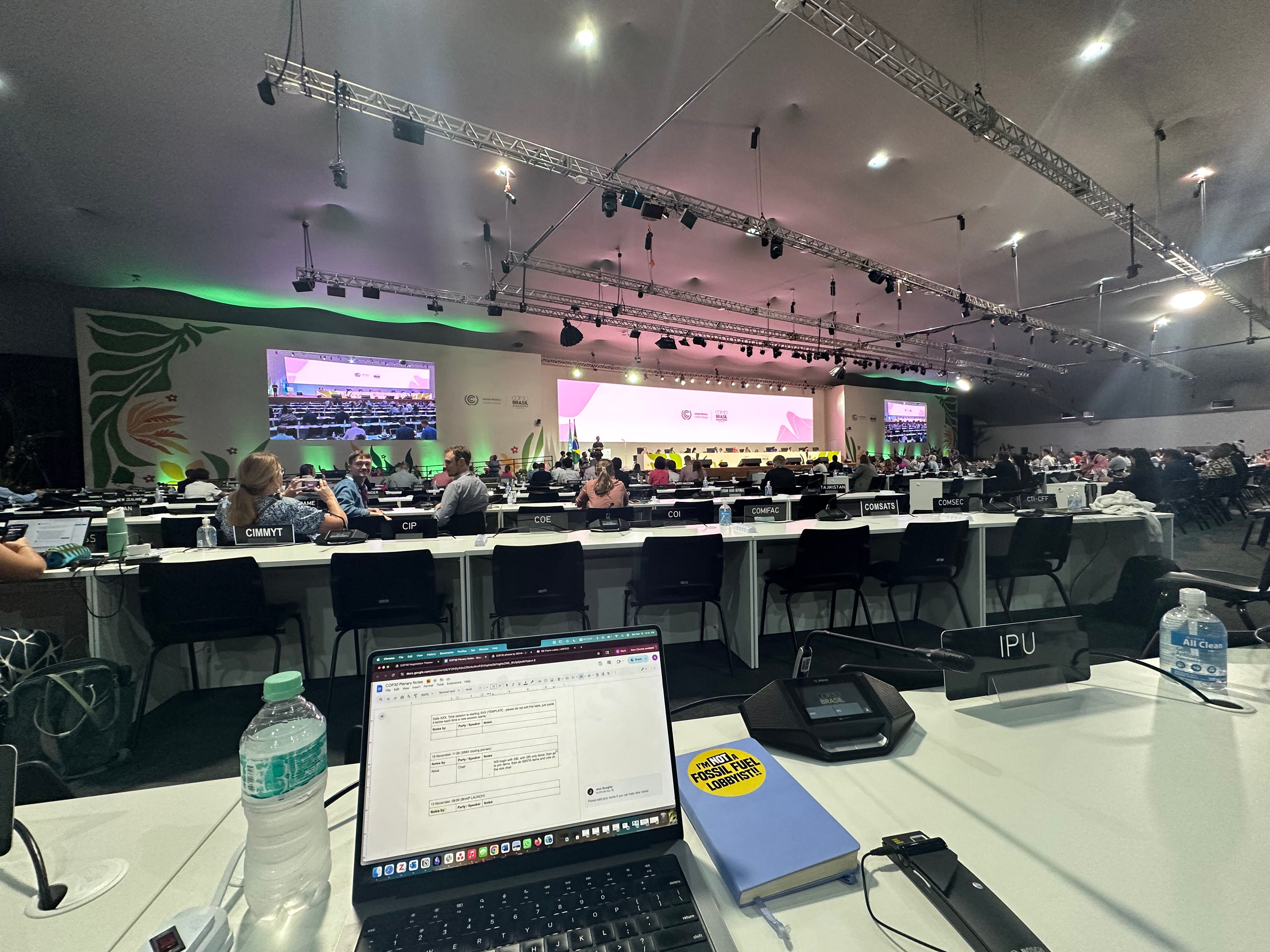
The end of week 1 at COP30 is upon us! Day 6 was the last official day of week 1 and day 7 was a “rest day”, where the conference venue is closed. But we all know there is not rest on these days as they are filled with strategic meetings and recaps, both on the Party negotiator side and the observer advocacy side.
In this post, I will recap where we are in terms of negotiations after week 1 and the tone of the conference so far. For the personal section, I’ll talk about how I’m feeling physically and emotionally after the first week, including about the venue, about Belem, food and drink ratings, and other reflections. Which section and how much you read is up to you!
Technical Section: Just Transition, GST, and Fossil Fuel Roadmap
The end of week 1 usually has the Subsidiary Body (SB) closing plenary, where draft informal notes and texts are either forwarded to the second week, where high-level ministers arrive and do negotiating on the decision texts, or are sent to the SBs next year. If a text gets sent to the SBs next year, it means there was no agreement on a way forward for that particular item. On Day 6, there were some last-minute negotiations and then the closing SB plenary.
Instead of going into the details of negotiation sessions, I want to give a high-level recap of what are the contentious issues that will be negotiated on during the second week. The JTWP and both GST items were forwarded to the second week at the closing SB plenary. There has also been an ongoing conversation of a roadmap to transition away from fossil fuels.
If you are interested in any other negotiation items than the ones I’m following or you want updates in a quicker fashion than this blog, I would recommend looking at IISD Environmental New Bulletin Daily Report, EESI COP30 Dispatch (more US focused), or subscribe to the Climate Diplomacy Brief. If you are also interested in how texts change throughout COP, I would recommend looking at Carbon Brief’s text tracker.
Just Transition Work Programme
As you recall from my previous posts, the Just Transition Work Programme (JTWP) aims to bring the concept of a just transition (meaning no one gets left behind while we transition to net-zero) into UNFCCC negotiations. The work programme was agreed to be established at COP27 (2022) and then was established with a scope of work at COP28 (2023). Since then, there have been four dialogues surrounding just transition topics with subsequent summary reports.
Here at COP30, there has been a lot of conversation surrounding how to bring this work programme beyond the dialogues into action and implementation. At the beginning of COP30, negotiators were working from this informal note. By day 5, there was new text available that tried to encompass all the views and reflections from Parties over the first week of COP30. This is the text that will be used starting in the second week. There will most likely new iterations of the text before the final (hopefully) decision.
One of the major changes from the informal note from the SBs and the new text on day 5 is the introduction of proposals to have an institutional arrangement for the JTWP. What is an institutional arrangement, you ask? Great question. It basically provides a way (whether a mechanism or plan) for how work is created, planned, implemented, and reported. The Technology Mechanism is an example. There are four options in the text (paragraph 27) for a type of institutional arrangement. Option 1 is to establish a just transition mechanism to “enhance international cooperation on and enable equitable, inclusive just transitions,” with a recommendation for a draft decision on this mechanism at the next SB session (June 2026). This mechanism would most likely operate separate, but still very much linked, with the JTWP. Option 2 calls on the SBs to develop a just transition action plan to, “enhance cooperation, capacities, and action on and foster just transition pathways,” with a recommendation for a draft decision on the action plan at the next SB session (June 2026). This action plan would operate within the JTWP and would complement other work streams. Option 3 is to develop a policy toolbox to, “support countries in advancing on their just transition pathways,” and would have a non-prescriptive set of tools to translate into action. Option 4 is to develop guidance for UNFCCC constituted bodies to implement just transition in their work. Essentially, these four options go from the most (option 1) to the least (option 4) in terms of establishing an institutional arrangement for just transition.
To recap all of my posts from the first week, here are the main sticky issues that will need to be resolved in the second week:
Whether there will be a just transition mechanism, action plan, toolbox, or mere guidance on the implementation of the JTWP. Most developing countries want the mechanism, whereas developed countries are split between the other options.
Issue of “gender equality” and whether it will be changed to “equality of men and women”. This has been a battle within the gender action plan negotiation stream as well.
Language surrounding the need for increased ambition to meet the 1.5 goal of the Paris Agreement. Some countries want to include mentions of scaled-up adaptation action and means of implementation (finance, capacity, technology) obligations of developed countries to developing countries within the context of sustainable development and poverty eradication. Others want the temperature goal to focus on emission reductions only. This is connected to the disagreement on whether the IPCC is “the best available science”.
Whether to have language that would integrate the outcomes of the GST1. Remember, the GST outcomes include transitioning away from fossil fuels and inefficient fossil fuel subsidies among other items that some countries may not want part of the JTWP (even though they very much are).
Including language on “transitioning away from fossil fuels” in relation to universal access to “clean, reliable, affordable, and sustainable energy for all”. Some developing countries argue on the need for fossil fuels to develop and increase energy access, particularly for clean cooking. From a health perspective, this is particularly important, but it would be concerning if this still leaves the door open for gas as opposed to electric cooking.
Language on the role of transitional fuels (not at all defined; normally means natural gas but theoretically could be a whole host of different fuels).
Language on trade-restrictive and unilateral trade measures. I went into detail on the disagreements in this post.
In terms of health, this new text has some mentions of health, which is a positive development. It also mentions sectors that are directly related to health, such as food production and energy access. There is also mention of health not only in the preamble (with the right to health and the right to a clean, healthy and sustainable environment mentioned), but also in the more operative paragraphs where the “meat” of the text is (mention of health related to clean cooking).
Global Stocktake Process
Let’s give a little refresher on this negotiation item. The Global Stocktake (GST), in general, is the report card of the Paris Agreement, assessing how well Parties and the world are doing in limiting the increase of global average temperature to well-below 2 degrees C and pursuing efforts to limit to 1.5 degrees C. The first GST concluded in 2023 at COP28. It had started 2 years prior with a technical phase, where there were three dialogues and opportunities for both Parties and non-Party stakeholders (think civil society) to input submissions. At the beginning of 2023 is when the political phase began, with Parties negotiating on what a GST outcome will be given the inputs from the technical phase. The outcome became the cover decision for COP28.
Now that the first GST is over, the time has come to start planning for GST2. Parties are thinking about what went well the first time and what can be improved for the next time. This is what this negotiation track is about. It’s important that there is a decision at COP30 because the technical phase would start in 2027, which isn’t too far away given the amount of logistics. It also gives a signal as to how the Paris Agreement will be evaluated pre-2035, which is an important year for many countries to peak their GHG emissions. COP30 started with an informal note that was sent from SB62 in June 2025. On day 3, a new text was dropped, which tries to reflect all the views of the Parties.
There are two main sticky points in this negotiation stream: (1) surrounding the IPCC as the best available science and (2) the timelines of the technical and political phases.
For the IPCC language, there has been a concerted efforts by some countries to change language explicitly saying that IPCC is “the best available science.” It is a signal that some are undermining the value and importance of IPCC reports in the UNFCCC process, including with Nationally Determined Contributions (NDCs). Those who are leading this effort say that the IPCC’s work and emission reduction pathways are unjust and inequitable and do not take into account research from developing and vulnerable countries (some of this concern is valid). Further, it is not a primary research source, but rather an assessment. As such, it should not be labeled as the best available science. It should be labeled as one source of best available science but should not be elevated above all other sources. In contrast, other countries are strongly pushing for language to not only include IPCC reports in the GST2 process, but also to label it as “the best available science”, citing that it is the leading scientific UN body on climate change research. As I’ve mentioned in my previous posts here at COP30, this effort to reduce IPCC’s role in the GST2 process is concerning, particularly as a scientific researcher myself.
This disagreement also feeds into the disagreement surrounding the timelines of the technical and political phases. There is agreement that the political phase needs more time in GST2 as it felt particularly rushed in GST1 (perhaps that’s why we got language on transitioning away from fossil fuels). However, some Parties want a longer political phase at the expense of a shorter technical phase, including reducing the number of dialogues to two. Other Parties want to keep the technical phase just as long but have an overlap period between the technical and political phases to make the political phase longer. They also want to provide some flexibility in the technical phase to include the IPCC AR7 report in the GST2. The problem is that the IPCC operates on a 7-year timeline, whereas the GST operates on a 5-year timeline. So, if there is no flexibility, including overlap with the political phase and some inter-sessional sessions, there is a risk that the IPCC AR7 report will not be incorporated into GST2. In my opinion, this would make the GST2 not an effective evaluation and not in line with the best available science. The implication is that the GST outcome (based on the technical phase) would not be an effective tool to raise ambition and action towards meeting the Paris Agreement.
GST UAE Dialogue
This negotiation item is still related to the GST, but instead of looking towards GST2, it goes back to GST1. At COP28, as part of the GST Outcome (paragraph 97), the UAE Dialogue on implementing the GST outcomes was established. It came from wanting some follow-up on the GST outcomes. The problem is that paragraph 97 is under the section header “Finance”, so some Parties are arguing the scope of the dialogue should be about finance to implement the GST outcomes. However, the sentence creating the UAE dialogue just says GST outcomes. So, other Parties want the dialogue to be about all GST outcomes. And this is part of the reason why this negotiation item has been held up a year longer than expected.
At the beginning of COP30, negotiations started on an informal note that came from SB62. On day 5, a new text was dropped, which merged the two versions into one.
The main disagreements for this negotiation track are with the scope, timelines, and outputs for the dialogue. For the scope, as I mentioned prior, there is disagreement on whether the scope should be finance or all of GST outcomes. For the timelines, some want the dialogue to take place every year until the GST2 or maybe being picked up after GST2, while others want the dialogue to occur only once as we are getting close to GST2 starting.
The more contentious issue is with regards to the outputs of the dialogue. Some Parties want an output from the dialogue, whether that be a summary report or an option for the summary report to then have a decision. Other Parties don’t want any report or output from the dialogue, stating that it would turn the dialogue into another stocktake. This may just be a tactic to prevent follow-up on the contents of the dialogue, which very well may be topics surrounding transitioning away from fossil fuels.
Roadmap to Transition Away from Fossil Fuels
One exciting development that occurred just before COP30 on November 7th is the call for the development of a roadmap and timeline for fossil fuel phaseout. This call came from none other than the President of Brazil, Luiz Inácio Lula da Silva. However, this never got on the agenda here at COP30 and was not even part of the COP30 Presidency Consultations that were occurring separate from official negotiations on NDCs, Biennial Transparency Reports (BTRs), Article 9.1 (obligation of developed countries to give funds to developing countries), and unilateral trade measures. However, the idea of a roadmap to transition away from fossil fuels (or lovingly called the TAFF), has gained speed in the corridors of the conference. Civil society and some countries are now taking this idea and pushing towards an official roadmap, or an agreement to make a roadmap. It will be interesting where this will land, whether in a cover decision or something else.
Personal Section: New Snacks, Less Busy, and a Party!


Alrighty, so I’m gonna break down this section into two parts. First, I’ll talk about day 6 and the “rest” day for day 7. Then, I will talk about my reflections on the first week of COP30. That way we don’t miss any daily activities, including new snack and drink ratings!
Day 6 and Rest Day
To begin, let’s talk about day 6. After a certain point at these conferences, negotiations start to be closed to observers. What does this mean for me? A lot of time finding a spot to chill and work on my computer. It also means the ability to have a good lunch, find an afternoon coffee, and even chat with colleagues for more than 5 minutes. It also brings a little more stress because you have no clue on the status of negotiations since you are no longer able to get into the room. The two things I had on my agenda was to go to the morning constituency meeting of the Research and Independent NGOs (RINGO), which normally gives a rundown of the status of the negotiations, and then the closing SB plenary at the end of the day, which decided what agenda items went to the second week for high-level minister negotiation.
As I had some free time, I had a little fun taking pictures with this giant globe that is in one of the buildings. I also started taking pictures of the various animal displays throughout the venue. I had lunch (more below on ratings) before the closing SB plenary and then was in the plenary for about 2 hours. Then, it was the end of the conference day. A pretty easy-going last day of week 1 to be honest. And the best part was the Saturday night party where civil society and others gather to have some fun after the first week.


Now on to the food and drink ratings. I’m going to start with a new chip flavor I tried called “churrasco”, to which I believe translates to BBQ, so I was excited. These chips definitely had a better flavor profile than the “cebola e salsa” chip flavor previously. They weren’t quite the BBQ flavor as in the US, much more toned down. And there was still not a lot of seasoning overall. I give these chips a 4/5 rating because I like the flavor slightly more than the other chips. But I still wish there was more flavor overall. For lunch, I had a roast beef sandwich that included some kind of amazonian herb relish that was absolutely delicious! It was a sort of tangy, onion, sweet flavor that complemented the roast beef quite well. And the bread was also good, just the right amount of crunch and fluff. My only qualm is the lack of roast beef in the sandwich. It maybe had 1.5-2 slices? I was hoping for something a bit more substantial, so that was disappointing. But overall, it was nice that I could grab it and sit on a couch to eat it. And there was no line, so I got it immediately. Plus, the people working at the counter was super nice and helpful. I give this sandwich a 4.5/5 rating.
For dinner, I had a fish and rice dish. I could not tell you what kind of fish it was, but it was flaky and tasted liked a combo of cod and salmon. I really enjoyed it! The rice was mixed with jambu, an herb from Amazonia that kind of makes your mouth cool and numb. It is very popular in this region. I’ve seen it at every restaurant I’ve been to. Unfortunately, it is not my favorite mainly because the sensation in the mouth freaks me out and reminds me of my nut allergy. But don’t worry, I’m not allergic to this herb. There was also this crunchy maize like substance that has a great texture and complements the dish. This dish was one of the better ones I’ve had, so I rate this a 4.5/5.


I also had the opportunity to have one of the ramen flavors on the late evening of day 6 and early morning of day 7 (there is normally a party at the end of week 1 to let off some steam!). I tried the BBQ flavor along with the orange juice box. The ramen was easy to cook in the microwave and provided much needed carbs for what ended up being a very late night. The flavor was…interesting. It was not the sort of BBQ I’m used to and it was a weird flavor for ramen. But it was fast to make and provided quick sustenance. I will rate this a 3/5, mainly because of the convenience. The orange juice was really good; more tart than sweet. And it was a perfect hydration packet to give some vitamin C. I give this a 5/5 rating!!
For the rest day (day 7), I was able to sleep in until 11am which was absolutely fantastic. But I had meetings starting in the afternoon to recap week 1 and look towards week 2. It was fairly light in terms of substance, but it was a long 4-hour meeting. The positive is that after the meeting, my colleagues and I decided to have a chill dinner at one of our apartments. We went to the grocery store to get some food from the deli (fish, chicken, rice, beans, salad) and had a family dinner situation. It was a great way to end the rest day and start week 2 on a good note. Plus, the company is always welcome.
Week 1 Feelings and Experience


Overall, week 1 of COP30 has been feeling pretty good. It’s been nice to be back in this space, in negotiation rooms, and doing something meaningful. It’s been a bit of an adjustment for the heat/humidity in the venue (a health issue!) and ensuring I have enough water to stay hydrated. But overall, it’s been a good experience. Sure, there have been some hiccups regarding leaks in the venue when there are torrential downpours. Or when they ran out of cards to pay for food and drinks in the venue. But I can’t imagine a COP that doesn’t have a few kinks to work out the first few days.
One thing that has been present here at COP30 are Indigenous Peoples’ voices and subsequent protests. During the first week, there were several demonstrations, both inside and outside of the venue, on the rights of Indigenous Peoples’ and their call for more participation in the UNFCCC process. One protest led to a security breach of the venue late Tuesday night. This then led to an escalation of military and police presence both in and outside of the venue. It’s been getting progressively worse in terms of this presence, capturing a picture that those who are being more affected by climate change are being met with a large show of force while those are contributing to the crisis the most is being protected. While there is always security at COPs, the large presence of military is quite alarming and gives a second take on the right to protest.
Though there have been some negotiation tracks with lots of disagreements, I would say the vibe of the conference overall is optimistic. There does seem to be a strong push from the COP Presidency to get a decision that will bring us closer to ambition to reach the Paris Agreement goals. It is also quite poetic to have this conference in/near the Amazon. The weather and temperature are quite the metaphor for the heating of the planet. There is always a torrential rain in the afternoon that rings throughout the venue. Sometimes thunder cracks and everyone jumps and become more alert than they were before. I feel like its nature telling us something, that it is present at the conference just as much as we are. I doubt I’m the only person who has thought this, but it really reminds me of the problem, challenge, and future we are all trying to address. The little thunder cracks are reminders of what we are fighting for. In that sense, I think this was the perfect spot to bring about real reflections of the UNFCCC and Paris Agreement.


I also want to take the time to mention the kindness and hospitality of the people here in Belem. Everyone has been so kind and willing to help if we need. When I went on my snack run at the grocery store, there was an employee with a COP30 shirt on that said “can I help you”. He spoke English and was going around the store to see if conference goers needed help finding anything. When he asked me, I asked him what ramen flavor he liked, to which he replied, “oh I don’t eat that.” So that was a nice conversation (haha). But this is just one instance. I had another instance where a couple who spoke a little English made sure we felt safe and said they would just be across the street in case we need anything. Plus, our apartment neighbor has sent us little notes with maps of where to find the best and cheap places to eat. It’s been a very welcoming experience overall.
Physically and mentally, I think I’m starting to feel the effects of a week-long conference. The amount of sleep you get in a night starts to slowly decrease. You stay out a little later because you leave the conference center late and still need to get dinner somewhere. Plus, your brain gets a bit exhausted having to navigate international politics, both for climate policy but also in general. You start to drink an extra cup of coffee, eat more snacks than meals, and check your phone for the latest intel on negotiations. It’s a high-stress environment for a long period of time. Luckily, week 2 has less negotiations (that are open to observers) and more sitting around waiting for new texts. I’m feeling cautiously optimistic going into week 2. Since I don’t want to jinx anything, that is all I will say about that.
Thanks for reading! Feel free to comment or ask questions below if you want to know anything specific and I’ll be happy to answer!
Saw the fire! Did it affect you?